Choose a Vehicle Charger Based on Ports, Power Claims, and Your Devices
A 100w usb-c pd car charger can be a useful category for drivers charging phones, tablets, or USB-C laptops, but the headline wattage alone does not tell you what one port can provide. Start with your device needs, cable, vehicle socket, and preferred port layout.
View Current OfferThis page may contain affiliate links. If you purchase through them, we may earn a commission at no extra cost to you.

Format-Based Options for Different In-Car Charging Setups
These listings are differentiated by their stated format and charging terms, not by independent performance testing. Before purchase, review the listing for the per-port output table, combined output when several devices are connected, vehicle input range, cable requirements, and socket fit.
Joyroom 175W Car Charger PD 3.0 100W Super Fast Charging USB C Car Phone Adapter for MacBook Pro iPhone 17 Samsung Galaxy S25 24
The Joyroom listing is the clearest match when a stated USB-C PD 3.0 and 100W charging claim is your main priority, particularly for buyers considering USB-C laptop charging alongside mobile devices.
- States USB-C PD 3.0
- States a 100W charging claim
- Advertises a 175W total rating
- Marketed for MacBook Pro, phones, and Samsung Galaxy devices
The supplied listing title does not provide its port-output allocation or supported vehicle input range.
View Current Offer
Mini 100W Car Charger Dual Port USB C PD And QC Fast Charging Cigarette Lighter Adapter Flush Fit For Smart Phones Tablets
Choose this mini dual-port format if you want a compact socket adapter with stated USB-C PD and QC fast-charging terminology for a phone-and-tablet style setup.
- States dual-port design
- States USB-C PD
- States QC fast charging
- Described as mini and flush fit
Its title does not state how output is divided when both ports are used.
View Current Offer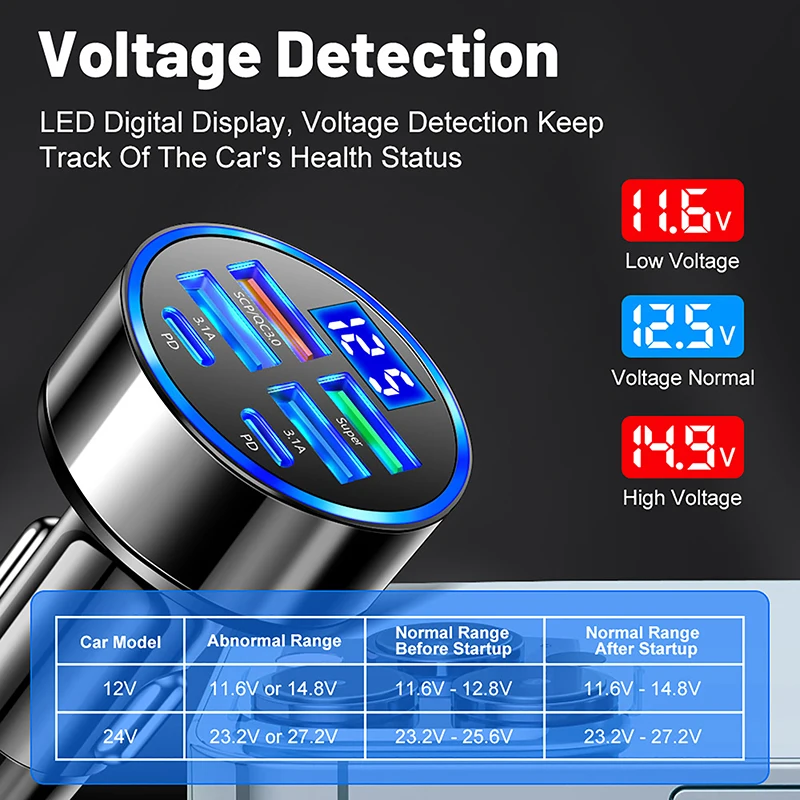
100W 6-Ports USB Type-C Car Charger With Voltage Display PD Fast Charging Power Adapter For Android Smart Phone Tablet
This format is worth considering when several devices need accessible charging ports and a voltage display is a desired feature.
- States six ports
- States USB Type-C
- Includes a stated voltage display
- Advertises PD fast charging
The title does not identify the output available from each port or during simultaneous charging.
View Current Offer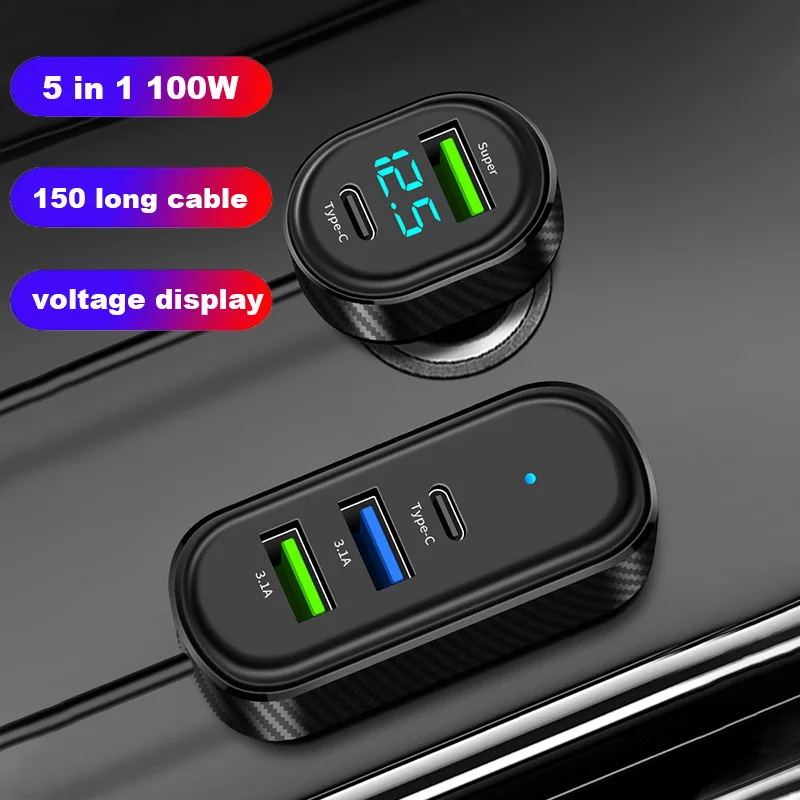
5-Ports 100W USB Type-C Front And Rear Extension Car Charger With 1.5M Extension Cable Fast Charging Power Adapter For Phone
Consider this layout when front-seat and rear-seat access matters more than a compact plug-in-only design.
- States five ports
- Includes a stated front-and-rear extension format
- States a 1.5 m extension cable
- Advertises 100W and USB Type-C charging
The listing title does not state per-port PD output.
View Current Offer
100W/200W QC3.0 PD Mini Car Charger 12-24V Lighter Fast Charging Car USB Type C Charger for Xiaomi Samsung Huawei iPhone Power
This mini charger is the relevant format to consider for shoppers whose vehicle requirement includes a listing that explicitly states 12V to 24V compatibility.
- Explicitly states 12V to 24V
- States USB-C PD
- States QC 3.0
- Described as mini
The title uses 100W/200W wording without explaining output conditions or allocation.
View Current OfferMatch Charger Capacity to Your Real In-Car Charging Scenario
A high headline wattage matters most when your device can request substantial USB-C PD power. For phone-only charging, port access and cable convenience may be more important than a high advertised maximum. For a phone plus tablet, a dual-port model can make sense, but look at the combined-output details rather than assuming both ports receive their maximum at once. For a USB-C laptop, establish that the laptop charges through USB-C, identify its required charging input, and choose a charger and cable that support that requirement. Use this short checklist before ordering: • Does your device support USB-C charging, and what input does it require? • What single-port USB-C PD output is needed for your main device? • What total output is available with multiple devices connected? • Is your USB-C cable suitable for the intended charging level and connector type? • Does the charger list compatibility with your vehicle's socket voltage? • Do you need a compact plug-in adapter, two ports, several ports, or rear-seat reach? • Will the charger and connected cables fit comfortably in your vehicle's socket area?

Understand USB-C PD, QC 3.0, and Vehicle-Socket Fit
USB Power Delivery, commonly called USB-C PD, is a USB-C charging standard that lets the charger and connected device negotiate power. A USB-A fast-charging port may use a different protocol, such as Quick Charge 3.0. Seeing both PD and QC terminology in a listing can be useful for mixed-device setups, but it does not mean every connected device charges at the same speed. Pay particular attention to single-port versus shared output. A charger advertised with a large total figure may distribute that capacity across multiple ports. A compact dual-port charger favors a simple front-seat setup, while a six-port model or front-and-rear extension layout is better suited to several passengers and devices. Separately, a car charger designed for one vehicle input range should not be assumed to work in another. Drivers of 24V vehicles should favor listings that explicitly state 12V to 24V support, such as the mini option included above.

100W USB-C PD Car Charger Questions
Can a 100W USB-C PD car charger charge a laptop?
It may, if the laptop supports charging through USB-C and the charger can provide the required USB-C PD output through the port in use. Laptop charging requirements vary, so match the laptop's charging needs with the charger's stated single-port output and use an appropriate cable.
Does a 100W car charger deliver 100W from every port?
Not necessarily. A headline wattage can describe a maximum or total capacity. Multi-port chargers may share output among connected devices, so the port-output table is the key detail for a specific setup.
Do I need a special USB-C cable for 100W charging in a car?
Use a USB-C cable whose stated power capability and connectors suit the device and charging level you need. A cable can limit the charging result even when the charger and device support higher USB-C PD power.
Can I use a USB-C PD car charger in a 24V vehicle?
Only choose one that explicitly lists an input range covering your vehicle's 24V system. Among the options above, the 100W/200W mini listing specifically states 12V to 24V compatibility.
What is the difference between USB-C PD and QC 3.0?
USB-C PD is a power-negotiation standard used through USB-C connections. QC 3.0 is a separate fast-charging protocol commonly associated with USB-A charging ports. Actual charging behavior depends on the charger, cable, and connected device.
Choose the Layout First, Then Match the Power Details
For the strongest title-level match to a stated 100W USB-C PD claim, start with the Joyroom listing. Choose a compact dual-port model for a simpler two-device layout, or move to a multi-port or front-and-rear format when passenger access matters. Review the relevant port-output and vehicle-input details for your intended devices before checkout.
View Current Offer