Hganus 50,000mAh Power Bank Review: Capacity First, Compactness Second
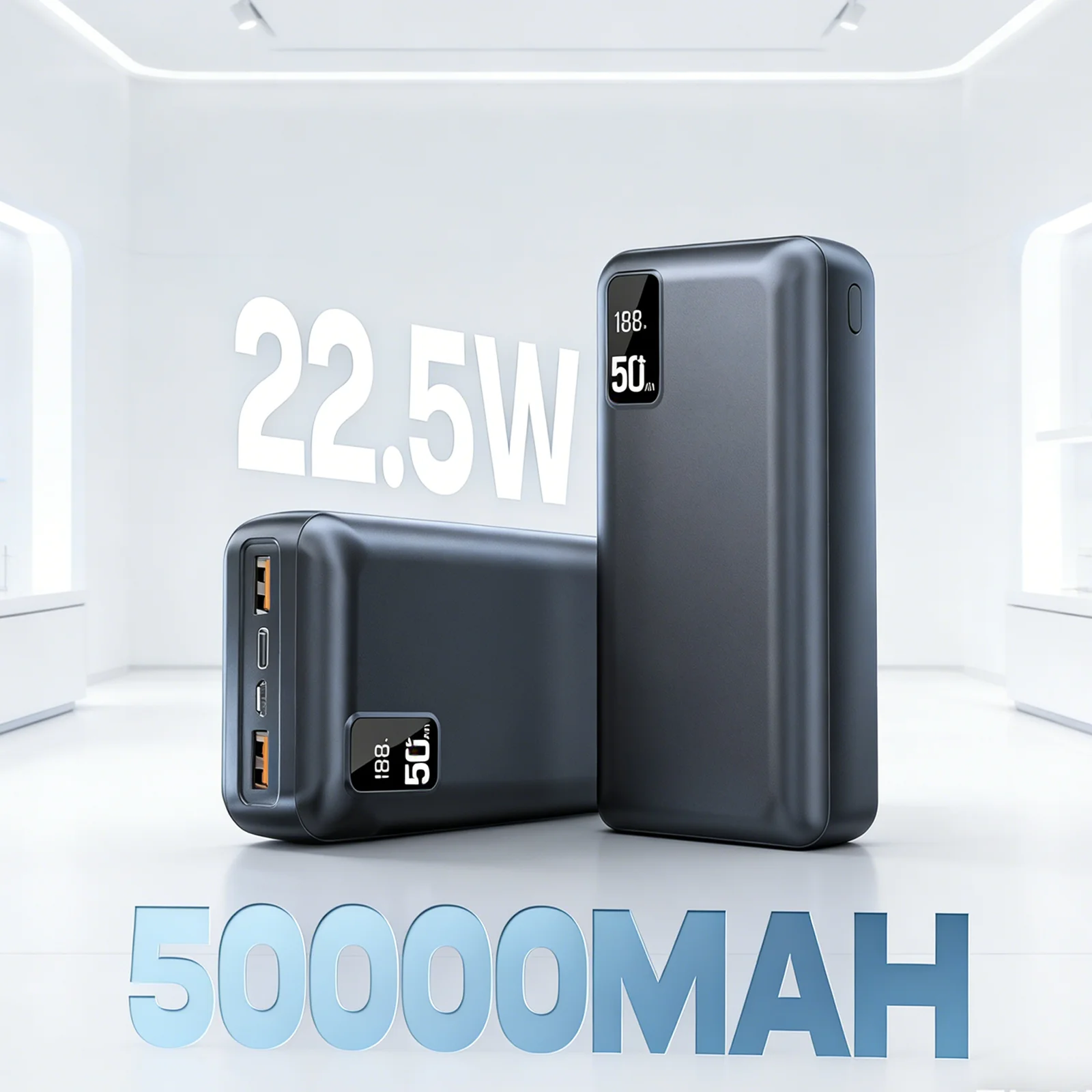
This 50000mah power bank review examines whether the Hganus portable charger makes sense for people who need substantial reserve power and advertised 22.5W PD/QC charging support.
View Current OfferThis page may contain affiliate links. If you purchase through them, we may earn a commission at no extra cost to you.
Hganus 50,000mAh Power Bank at a Glance
Who Should Choose This High-Capacity Hganus Power Bank?
The Hganus listing is aimed at a different job than a slim everyday battery pack. Its advertised 50,000mAh capacity puts the focus on keeping power available through long days away from outlets, road trips, emergency kits, or situations where more than one phone or tablet may need attention. That reserve is the central reason to consider it.
The other notable listing claim is 22.5W charging with USB Power Delivery 3.0 and Qualcomm Quick Charge support. For a device and cable that support a compatible charging profile, those standards can enable faster charging than a basic USB connection. They do not mean every connected device will receive the same output, since charging is negotiated between the bank, cable, and device.
Capacity figures are useful for comparing power banks, but they do not translate directly into a guaranteed number of full phone charges. Internal battery voltage, conversion from the power bank to USB output, cable losses, and the phone's own charging process all affect the result. Still, a bank in this capacity class is built around extended reserve power rather than a single top-up.
Choose this model if advertised capacity matters more than a pocket-friendly shape and you want PD/QC support in a backup-power charger. Skip it if your priority is a light bank for daily commuting, because a smaller-capacity model is generally the more natural fit. Before ordering, use the current product page for one quick check of port and input configuration, return terms, and the labeled Wh value if you intend to fly.
Reasons to Consider It
- Advertised 50,000mAh capacity is suited to extended backup-power needs.
- Advertised 22.5W maximum charging supports PD 3.0 and Qualcomm Quick Charge.
- A potentially practical category for keeping phones and tablets powered away from outlets.
Points to Weigh First
- A high-capacity power bank is less suited to pocket carry than a smaller everyday model.
- Actual recharge results depend on the connected device, cable, and charging conditions.
- Current port layout and input details are important to confirm before purchase.
- No independent hands-on performance evidence is included in the available context.
See the Current Hganus Offer
Review the current product page for the port configuration, input specifications, return terms, and the latest buyer feedback before making a decision.
View Current OfferWhat the Advertised Capacity and 22.5W Charging Mean
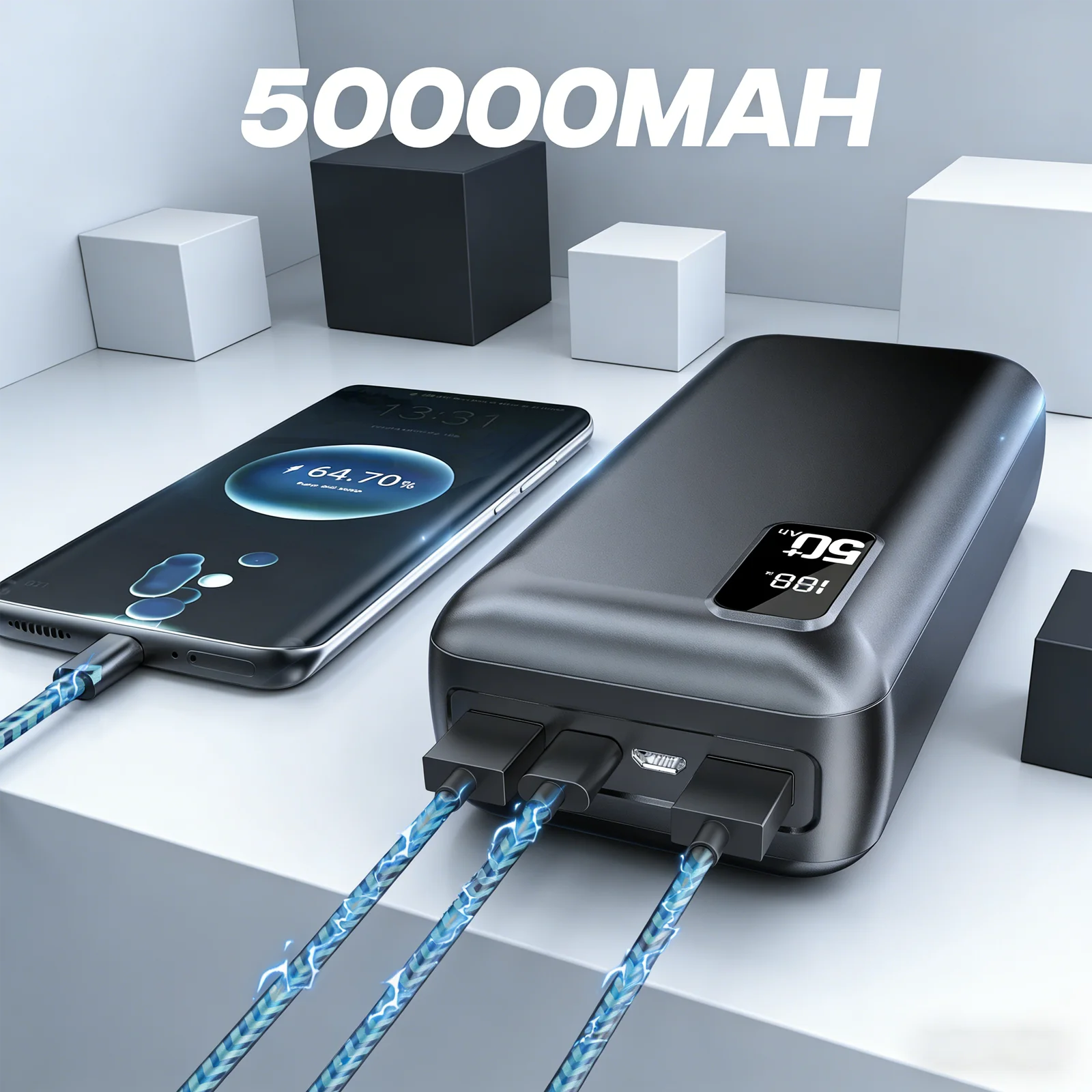
The advertised 50,000mAh figure describes a large internal battery reserve, not an exact number of device recharges. A phone with a battery rated around 5,000mAh might appear, on a simple capacity comparison, to allow up to ten charges. Real delivered energy is lower because a power bank must convert voltage for USB output and charging itself is not lossless. Treat that simple comparison as an illustration, not a promise. The advertised 22.5W maximum is similarly a ceiling rather than a fixed speed. USB Power Delivery 3.0 and Qualcomm Quick Charge are protocols that allow compatible equipment to negotiate an appropriate charging mode. A compatible phone and suitable cable may charge faster than with a standard low-power connection, while devices without a matching profile can charge at a lower rate. The listing positions this model for phones and tablets, but the practical result depends on the complete charging setup. For multi-device use, reserve capacity can be more valuable than speed alone. However, port count, simultaneous charging behavior, and how output is shared are configuration details that matter when several devices will be connected. They should be part of the pre-purchase check rather than assumed from the capacity rating alone.
Portability, Recharge Planning, and Air Travel
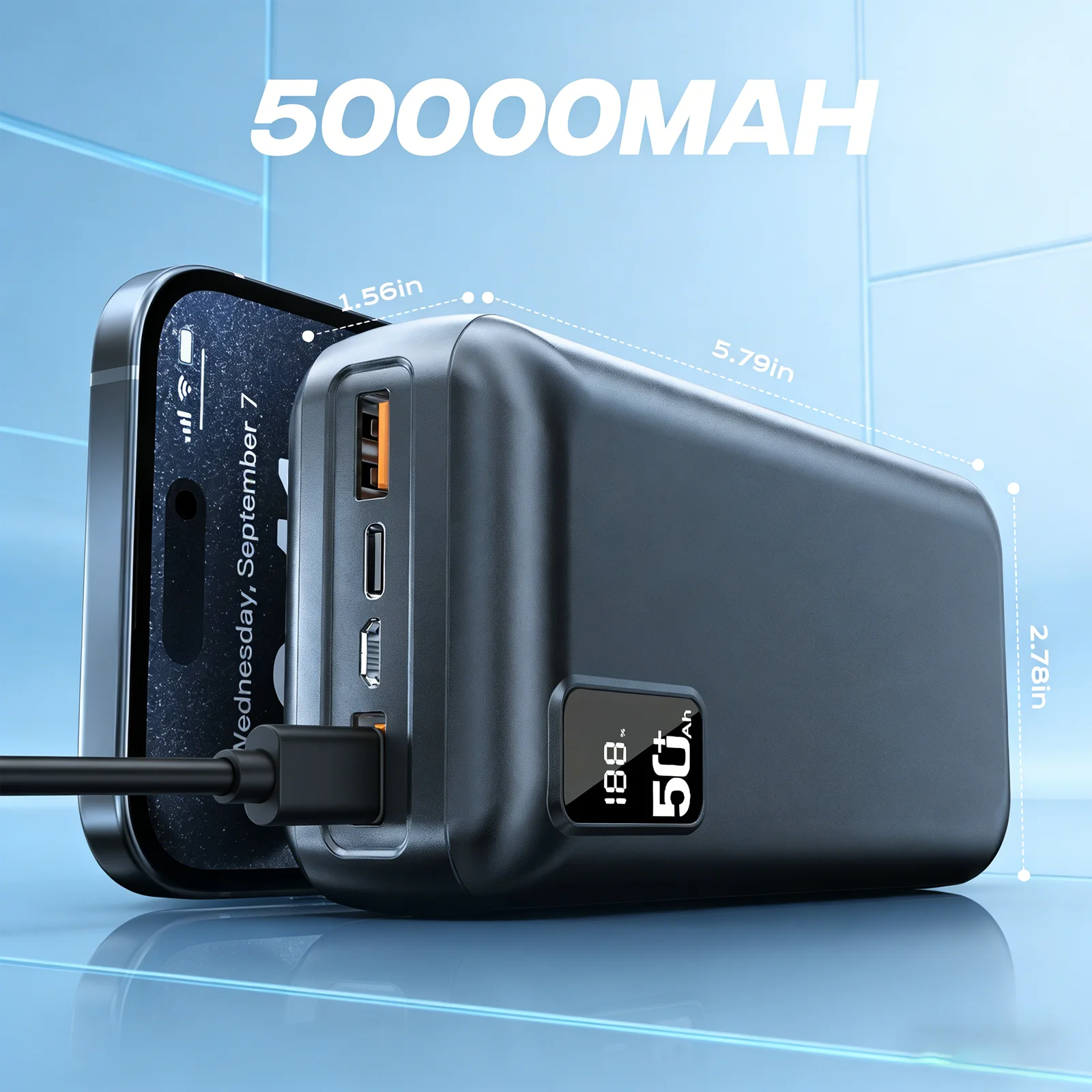
A power bank designed around 50,000mAh belongs in the high-capacity category. That makes it more appropriate for a bag, vehicle, work kit, or emergency supplies than for slipping into a pocket every day. It will also need recharge planning: a battery reserve of this size can take a substantial period to refill, and the actual time depends heavily on its input capability and the charger used. Air travel requires a separate decision. Airlines regulate spare lithium batteries by watt-hours and their own carrier rules, not by mAh alone. Do not assume this model is permitted or prohibited based solely on its stated capacity. Read the Wh label on the unit and check your airline's current requirements before flying. The practical decision is straightforward. Pick a bank like this when reserve power is the priority, particularly for trips, outages, or multiple personal devices. Pick a smaller model when routine portability and easier recharging matter more than having the largest possible battery reserve.
Hganus 50,000mAh Power Bank FAQ
Is a 50,000mAh power bank allowed on a plane?
It depends on the power bank's watt-hour rating and the airline's current rules. Airline policies for spare lithium batteries use watt-hours, so check the Wh label on the unit and confirm the carrier requirements before travel.
How many times can a 50,000mAh power bank charge a phone?
There is no single guaranteed answer. A simple mAh comparison can suggest several charges for many phones, but voltage conversion, energy losses, the phone battery size, and charging conditions reduce the usable result. Treat capacity comparisons as estimates, not promised recharge counts.
Does 22.5W charging mean every phone will charge at 22.5W?
No. The advertised maximum depends on the phone, cable, charging protocol, and power bank configuration. Compatible devices may negotiate a faster mode, while others can charge at a lower rate.
What is the difference between PD 3.0 and Quick Charge?
USB Power Delivery 3.0 and Qualcomm Quick Charge are charging standards that help compatible chargers and devices negotiate power delivery. Device support varies, so one standard is not automatically better for every phone or tablet.
How long does a 50,000mAh power bank take to recharge?
Recharge time depends on the power bank's supported input, the charger connected to it, and charging conditions. A high-capacity model can require substantial recharge time, so it is best replenished before a trip or other extended time away from outlets.
Is the Hganus 50,000mAh Power Bank Worth Buying?
This is a listing worth considering for backup-power, road-trip, and multi-device users who prioritize the advertised capacity and PD/QC support over compactness. It is not the natural choice for pocket carry. If that trade-off fits your needs, check the current listing details before ordering.
View Current Offer