QOOVI 60000mah power bank review: A Large Reserve Power Option
This 60000mah power bank review examines whether QOOVI’s advertised high-capacity, 22.5W PD/QC 3.0 model suits your charging needs. It is a listing-based specification and buyer-suitability assessment, not a hands-on test.
View Current OfferThis page may contain affiliate links. If you purchase through them, we may earn a commission at no extra cost to you.

QOOVI 60000mAh Power Bank at a Glance
Who Should Consider This Extra-Large QOOVI Power Bank?
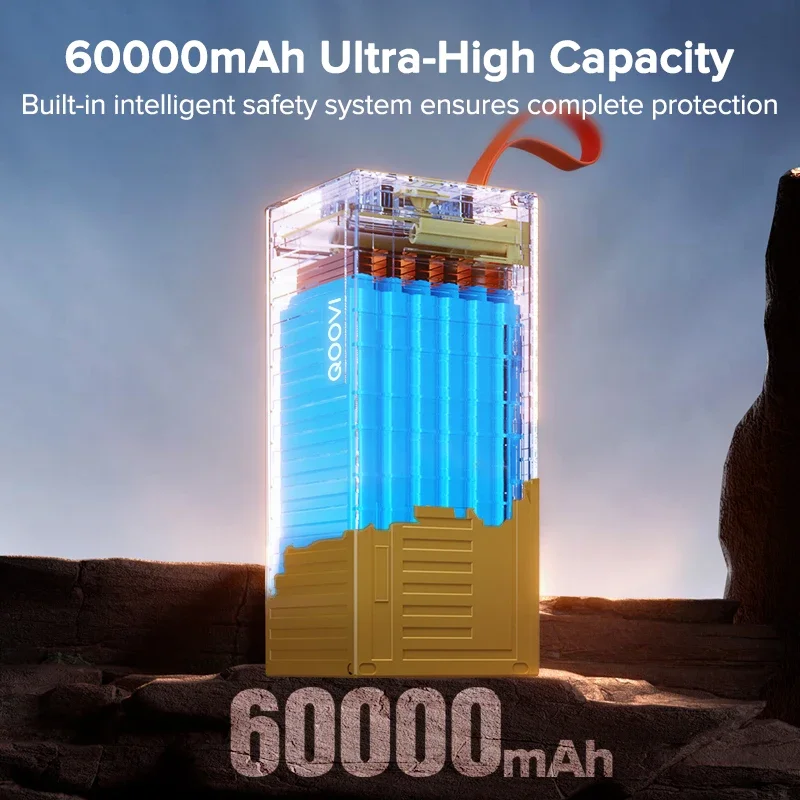
The QOOVI power bank is aimed at a very specific kind of charging problem: needing a substantial reserve of power when a wall outlet may not be convenient for an extended period. Its headline proposition is an advertised 60,000mAh capacity alongside advertised support for 22.5W PD and QC 3.0 charging. That makes it more relevant to bag-based, vehicle-based, or stationary backup use than to someone looking for a slim emergency charger to keep in a pocket.
A large-capacity power bank can make sense for long rail or car journeys, time at a campsite with access to permitted charging gear, outage preparation, or keeping personal electronics topped up away from mains power. It can also appeal to people carrying devices with larger batteries. The central attraction here is reserve capacity, not minimal bulk.
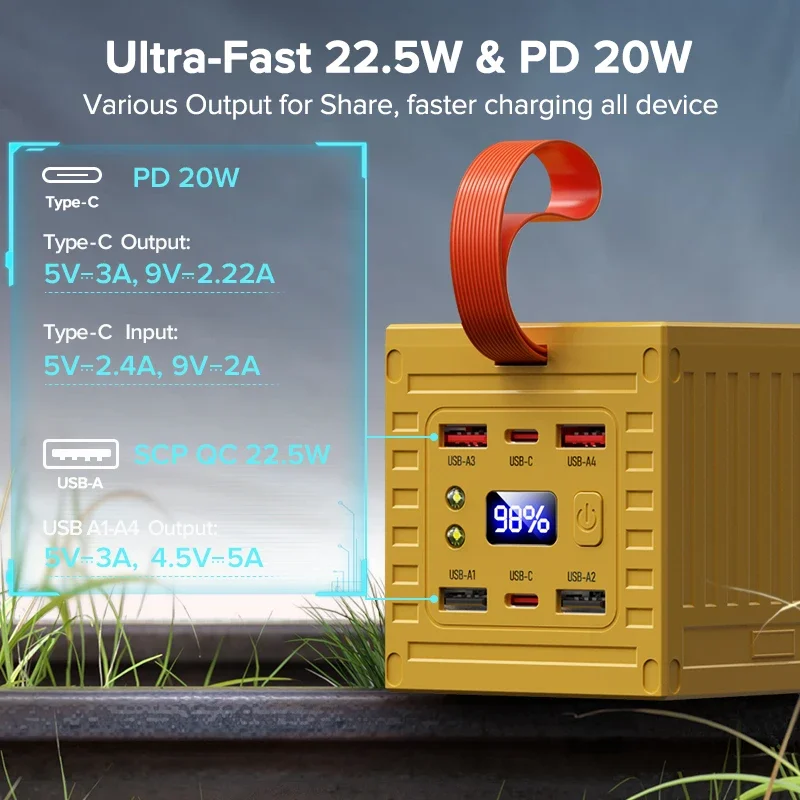
The fast-charging claim is worth treating realistically. PD and QC 3.0 are charging protocols, so a compatible device may charge faster when the power bank output, cable, and device negotiate a supported profile. The advertised 22.5W figure is a maximum claim, however, rather than a promise that every connected phone will receive that rate. iPhone, Xiaomi, and other phones can have different charging behavior depending on their own supported standards.
This is not the default choice for everyday carry or flight-dependent travel. A 60,000mAh-class battery is likely better suited to a bag, vehicle, or fixed spot where carrying convenience is secondary. Before ordering, focus on three consequential details in the current product information: the labeled watt-hour figure, the dimensions and weight, and the actual port and input configuration. Those answers determine whether this model fits your devices and travel plans.
Reasons to Consider It
- Advertised 60,000mAh rated capacity targets shoppers who prioritize a large power reserve.
- The listing advertises 22.5W PD and QC 3.0 fast-charging support.
- Its large-capacity category is well suited to bag, vehicle, and stationary reserve-power scenarios.
Important Trade-Offs
- A power bank in this capacity class is unlikely to be the natural choice for pocket carry.
- Airline eligibility can be restrictive and depends on the battery’s labeled watt-hour rating and airline policy.
- The current listing should be checked for port types, input charging details, and shared-output behavior.
Confirm the Configuration That Matters
Review the current offer for the labeled watt-hours, dimensions and weight, plus the output and input ports. These details matter more than the headline capacity alone when choosing a large power bank.
View Current OfferRated Capacity, Usable Energy, and Fast-Charging Expectations
A 60,000mAh rating describes the battery cell capacity claimed by the product, not a direct promise that a phone receives the same number of milliamp-hours. A power bank must convert its internal battery voltage to USB output, and some energy is lost during conversion and charging. Results also vary with the phone’s battery size, cable, charging conditions, and the power bank’s design.<br><br>For the same reason, it is better not to predict a fixed number of full phone charges. The advertised PD and QC 3.0 support may be useful with compatible equipment, but fast charging requires the right combination of device, cable, port, and charging protocol. A maximum advertised output does not mean every device will charge at that maximum rate.
Portability and Air Travel Need a Different Standard
The main trade-off of a 60,000mAh-class unit is capacity versus portability. This category is generally a better fit for a backpack, car, desk, or base-camp setup than for carrying in a pocket throughout the day. If physical carry is important, compare the current dimensions and weight with a smaller power bank before deciding.<br><br>Flying adds another consideration. Airlines typically assess spare lithium batteries by watt-hours rather than milliamp-hours, and batteries of this size may exceed common carry-on thresholds. Calculate watt-hours using the voltage and capacity shown on the product label, then consult the policy of the specific airline before traveling. Do not assume that a power bank of this capacity will be accepted for a particular flight.
QOOVI 60000mAh Power Bank Questions
Is a 60,000mAh power bank really able to deliver 60,000mAh to a phone?
Not directly. The rated capacity refers to the power bank’s cells, while charging a phone involves voltage conversion and energy loss. The energy a device receives depends on the power bank design, the phone, the cable, and charging conditions.
Does the QOOVI 60000mAh power bank support fast charging?
The product title advertises 22.5W PD and QC 3.0 charging support. Actual charging speed depends on whether the selected port, cable, and connected device support a compatible charging profile.
What does 22.5W PD/QC 3.0 mean for iPhone, Xiaomi, and other phones?
It indicates advertised support for common fast-charging protocols. A compatible phone may negotiate faster charging, but protocol support varies by device and a maximum advertised wattage is not a guaranteed rate for every phone.
How long does a 60,000mAh power bank take to recharge?
Recharge time depends heavily on the power bank’s supported input wattage, the charger used, and the cable. For a battery this large, input capability is an important specification to consider alongside output charging claims.
Can I take a 60,000mAh power bank on a plane?
Do not assume so. Airline policies commonly use watt-hour limits for lithium batteries, and a power bank of this capacity may exceed those limits. Use the labeled voltage and capacity to calculate watt-hours, then confirm the airline’s current policy.
What details should I check before ordering?
Prioritize the labeled watt-hour rating, dimensions and weight, output port types, input options and recharge capability, whether output is shared when more than one device is connected, and what cable or indicators are included. Also review the latest seller and listing information before ordering.
The Verdict: A Purpose-Built Large Reserve, Not an Everyday Essential
The QOOVI model may be worth considering if you specifically want a very large advertised power reserve and can accept a bag or vehicle-oriented form factor. Its advertised PD and QC 3.0 support adds appeal for compatible devices. Choose a smaller, clearly documented alternative instead if pocket carry or reliable air-travel eligibility is central to your needs.
View Current Offer